Music video
Brief:
You have four weeks to make a music video using a song that the group chooses. You will not have every lesson after half term.
You will need to do research in order that you have considered the below, with reference to existing music videos and theory. Both how you the research is relevant, and how you will use the research to develop your own work. You need a page on your blog for this work. Choose at least three existing music videos to reference for each of the below 1-4
1. Genre
a. Watch existing music videos in a certain genre b. write about how the producer of the music video applies the standard conventions of, eg rock, or whether they change what’s expected (and how) c. how you would apply this
2. Narrative
3. Performance
4. Editing
5. Equipment
6. Style – costume/colours/background/setting
7. Camera shots
8. Existing theory/concept/article
1-2. Genre and narrative
Dance/electronic
Electronic music is music that employs electronic musical instruments digital instruments, or circuitry-based music technology in its creation. It includes both music made using electronic and electromechanical means.
Dark Horse by Katy Perry:
In this example the electric instruments are most prominent during the opening of the song and during the build u to the chorus.
This music video has a semi solid narrative in which there is a visible plot line but not so much a 'story'. It depicts Katy Perry herself as an Egyptian leader flaunting her power while her 'subjects' offer gifts such as jewels to please her.
Pop
Pop is a genre of popular music. Identifying factors usually include repeated choruses and hooks, short to medium-length songs written in a basic format (often the verse chorus structure), and rhythms or tempos that can be easily danced to.
Hot n cold by Katy Perry:
This song can be categorized as a pop song as the rhythm is very upbeat and 'danceable' it follows the same format as other pop songs therefore having a strong chorus and reached the three on the number three in the billboard hot 100.
This music video has a strong narrative and follows the story of a a about a couple at the alter about to be married when the groom appears hesitant- this leads on to a cat-and-mouse game of the bride chasing after the groom, finishing with the pair completing the ceremony.
Hip hop
Hip hop music, also known as rap music, is a genre of popular music developed in the United States by inner-city African Americans and Latino Americans in the Bronx borough of New York City in the 1970s. It consists of a stylized rhythmic music that commonly accompanies rapping, a rhythmic and rhyming speech that is chanted.
Empire state of mind by Jay Z feat. Alicia Keys:
This song consists of mostly rap but has a chorus that is sung. It has a strong rhythmic beat behind it and is often perceived as a prime example of Hip hop music.
This music video does not have a narrative but rather shows a series of black and white images of New York city interspersed with videos Jay-Z and Keys shown performing the song in various locations in New York.
Theory
Genre: Andrew Goodwin
Goodwin's music video theory states that every music video must consist of these eight principles:
1. A link between visuals and audio/music-A director of an upbeat song may want to add a dance routine segment in the video to reflect the style. This is also used in editing- a slower, perhaps sadder, song may have longer shots in the edit.
2.Links between the lyrics and visuals-Music videos will often contain props or actions that show a direct link to the lyrics of a song
3.Display of the typical genre conventions- Music videos end to reflect aspects of their specified genre in the visuals. For example, the conventions of the rap genre typically consist of low angle shots, cars and money, this can be shown in the music video empire state of mind shown above. when Jay z is shown to the camera many low angles looking upwards at him are shown. He is also wearing jewellery and clothes that reflect his wealth such as gold chains and sunglasses.
4.A variety of intertextual references-This is when a video will make reference to another media text. For example the music video for Love Story by Taylor Swift makes reference to Romeo and Juliet by William Shakespeare.
5.Notions for looking-When the actor or singer in the music video looks directly into camera thus breaking the fourth wall. This allows the audience to connect more with the actor/singer in relation to the song.
6.Voyeurism: Essentially voyeurism is the idea of looking at something for sexual satisfaction. Women are more often treated in this way through the use of camera angles and fragmented body shots.
7.Demands of the record label- The artists record label may require certain things from their performer to (for example) maintain their presented image to the audience. For example there may be restrictions on clothing to some performers whose music has a large audience of young teenagers.
8.Music videos are either performance based, narrative based or concept-based- All music videos will fall under the category of performance (Most commonly seen in heavy metal videos where the band will be in front of a live audience) or concept (where the video presents an idea which is displayed in the mis en scene. This doesn’t have to be related to the music).
Narrative- Todorov
Tzvetan Todorov is a Franco-Bulgarian philosopher. He came up with the 3 act structure for films. It is a model used in writing and evaluating modern storytelling which divides a screenplay into three parts called the Setup, the Confrontation and the Resolution.
Todorov suggested that stories/films begin with an equilibrium where opposing forces are in balance. An event then happens which disrupts this balance, followed by a series of events. These problems are then solved to restore balance.
'Three Act Structure' is:
-Equlibibrium
-Disruption
-New Equalibrium
Todorov also suggested that conventional narratives are structured in five stages:
1.A state of equilibrium at the start.
2.A disruption of the equilibrium by some action.
3.A recognition that there has been a disruption.
4.An attempt to repair the disruption.
5.A reinstatement of the equilibrium.
3. performance
Ocean eyes by Billie Eilish:
This is a dance performance music video where the main focus of the music video is the performance. These types of music videos are sometimes created by solo artists, when they have no 'band' to perform with, and so create a performance by using a different medium, in this case dance. Similar performances are often shown during live concerts by solo artists that feature choreography and other forms of entertainment than just singing/music. They almost always contain back up dancers to help create a show to the audience and fill up the stage they're performing on.
A sky full of Stars by Coldplay:
This is a strong example of a performance based music video, it contains clips of the band performing together to the camera. Performance based videos can also contain other features and not solely rely on the performance, as shown here, Chris Martin, the lead singer seems to be the main focus of the video until the rest of the band is revealed later on.
4. Editing
Editing is often a prominent feature in many popular artists music videos. This can be seen by using editing features like green screens and animations.
No tears left to cry by Ariana Grande:
Here is an example of a music video that shows many different transitions and effects that have been created in post production of the music video. During the beginning of the video Grande is seen walking on the ceiling of a hallway. Realistically this effect is fairly simple by filming either upside down or flipping the video footage but the video goes on to show some incredible footage presented as the background/location of the music video which would have required a green screen.
The scientist by Coldplay:
This music video shows some great editing skills; as the video is shown in reverse the character played by Chris Martin lip-syncs the lyrics in forward time. However, this means that when the music video was being filmed Martin would have been acting in the video normally but lip-syncing the lyrics backwards so that when, during the editing stage the video was reversed it would look like Martin was lip-syncing the lyrics normally. This can be a very confusing concept to understand!
For my own music video:
Equipment:
All equipment we will be using will be from our colleges supply, so we will have to book it in advance. We will be using a DSLR camera, a tripod as our baseline equipment however we may use other things to get certain shot types. for example a shoulder mount for a ped shot or a slider to get a dolly shot where the camera slowly moves forwards or backwards.
We have decided that our chosen song for our music video is Everybody wants to rule the world by tears for fears. The genre of the song is in three categories Rock, Synth-pop and New wave.
Style-costume/colours/background/setting:
The style of the music video will follow quite a casual take as the pace of the song is quite calming and slow, to mimic this I would want to avoid any bright/vibrant colours. In regards to clothing I would want to follow an 80s theme as it goes hand in hand with the rhythm of the song and pays homage to the origin of the song which was released in 1985.
The setting/background of our music video will most likely be many different places, some ideas so far include: on a bus, a field, a street and a classroom, for parts where lip syncing is involved one idea is to have a section where the main character is looking at the camera head on, walking down a hallway or something similar, to 'break the fourth wall'.




Camera shots:
We aim to use a wide variety of different camera shots and angles with the equipment shown above.
Pan- the camera horizontally swivels from a fixed position, right to left or left to right
Tilt- the camera 'vertically' moves from fixed position, up to down or down to up
Ped- short for pedestal, the camera physically moves up or down, whilst still looking forward
Dolly- the camera smoothly moves backwards or forwards
Track- with this movement, the camera moves from side-to-side while still looking forwards
Zoom- the camera says still, but the camera lens moves closer or further away from the subject
Crane- the camera is fixed to a crane and moves around in the air
Steadicam- the camera will move round in a smooth, steady and stable way
Due to college resources we wont be able to use any crane shots as that would require special equipment which we do not have. However, we will make a conscious effort to include as many other shot types as we can while making sure not to overload our music video with unnecessary footage.
Pre production
Roles
Script supervisor-everyone (will this edit together? Do the actors have different clothes on different days!?)
Data wrangler-Ruby– ensure footage is relabelled and on more than one computer
Director-Annabelle – directs actors, ensures the look is achieved
Cinematographer-Freddy – camera – ensures look is achieved via framing and manual settings and camera movement
Lighting-Dylan- making sure the lighting quality is good, no dull scenes, the lighting has to fit with the scene
Actor-Amber and Nyah
Costume/makeup/hair-Nyah
Producer-Amber
Assistant producer-Annabelle
Song- Everybody wants to rule the world- By tears for fears
The song's lyrics detail the desire humans have for control and power. The lyrics are deigned to be applicable to different scenarios such as short lived financial success and the cold war, the latter being a key political interest when the song was released in 1985.
The song itself has a calming rhythm with a smooth beat. The song is set in the key of a D major. D major is a key that is often associated with Halleluiahs, war-cries and victory-rejoicing. It is often used in emotional pieces to connote hope. However the song itself is considered somewhat depressing, this is because although the bpm is 116 the lyrics are sung in a slower way.
The original video includes a performance piece of the singer facing the camera and performing and shots of a person travelling across America. There isn't a strong narrative and focusses more on aesthetically pleasing shots such as the driving with the sunset in the background shot towards the end of the music video.
Shot list
Here is the shot list that I have created, it consists of five different scenes with roughly 3-4 shots in each scene, the majority of the shots are still, using a tripod, however we have included a track shot as well. The shot list is not meant to be strict so we are able to change stuff on the day if we think we need to or if something unexpected happens, for example bad weather, road closures etc.
Risk assesment
By creating a risk assessment we know what we have to look out for n the day, for example one of our locations we plan on using will be in a bowling alley, here there may be members of the public who do not wish to be filmed/shown on camera and so we must be respectful of their decision.

Storyboard
Locations
.png)
The main location feature of our music video will be in bowling alley/arcade, we have chosen this as it will give us a chance to get some really nice aesthetic shots with the led lights present. Our other locations are on an empty street and at a bus stop- these locations are mainly to add to the narrative of the music video but filming in an empty will give us a chance to maybe do some lip syncing/performance shots.
Costume inspiration/style

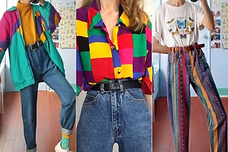
Our planned style for the music video will be 80s inspired, paying homage to the year the song was released (1985). Some features of this style are loose fitting clothing, bright colours, denim, use of accessories such as belts and visible makeup, such as red lipstick. Here are some images and examples of what we will be using for inspiration.
Final music video
The editing process
Firstly, I placed all the clips in chronological order on my timeline in premier
Next I individually cut them down to what was useable and what, in my opinion, was not. Unfortunately at this stage I realised that we had a lot of shots where the camera was too shaky where our cameraman has not used a stabiliser.
After this, I added the soundtrack to the timeline and began to sync the clips to the song and cut them down further so the beat of the song followed the sequence of clips shown.
Once I had completed this and had my main clips in the correct places I began to focus on the transitions, for example towards the first third of the music video there is a transition where the camera pans to face the sky and then back down to a new location. For this particular transition I had to use a 'dip to white' effect to make sure that the transition flowed as before the cut between clips was too obvious and messy.
Finally I made some final edits to refine the music video and then exported the project and uploaded it to Youtube.
Evaluation
This is the final result of the music video,
Things that went well:
In my opinion the highlight of the music video is the arcade scene, the lighting of the arcade fitted really well with the theme of the music video along with the costumes/clothing of the actors.
- Apart from some shaky camerawork the video transitions came along nicely and almost seamless.
Problems that occurred:
-One of our crew members didn't show up for one of the shoots, this meant that we had to reorganise roles for that shoot and so we missed some crucial filming time.
-On one of the days we were filming it started to rain, and as we were unable to reschedule, some scenes may look slightly different in terms of weather.
-We realised that a lip syncing scene wouldn't fit the music video well as the song is sung by a male voice and so it would look odd, we initially thought it would be okay but on the day of filming we decided to skip it and instead get more footage on other areas that we thought would fit the music video better.
- Because of some of these issues during editing I decided to create a shorter higher quality music video rather than complete the song to a lower standard.
Overall, we did face some bad luck with the weather but we were just in an unfortunate predicament. Next time, I would make sure to get enough usable shots by checking them more frequently after recording to make sure they're all of a high quality. This was the main issue to why I couldn't complete the full music video.I am pleased with the final outcome,
plan:
How did you prepare and how well did you communicate as a group? And how would you organise better next time?
We had prepared to a good extent, we each knew our roles and what we were to do. However we could have improved by having more back-up solutions. Communication in our group was unfortunately flawed, with one member not showing up to 2/3 of our shooting days with no notice this led us back and created quite a few issues which then delayed filming and the time we had to shoot.
Do:
How well did you work together on shoot days?
Shoot days were very successful and everyone worked together well and contributed equally
What were the biggest challenges and difficulties you faced, how did you overcome these?
A challenge that effected us was the weather during filming. On one of the days the weather was wet and rainy compared to the others but we were filming in the same place. This meant that it would look different when the clips were then shown together. Unfortunately we didn't have any time for reshoots so we had to just go along and use the shots from that day.
Review:
If you could improve one skill, what would it be and why?
One skill I would want to improve would be editing as that's my main interest in media. If I could change one thing in the music video we created would be the camera work. I think that the camera was too shaky and could've been improved a lot if our camera person had used a stabiliser instead of just holding the camera directly
What would you take from this into your EPQ?
I would use a smaller team for filming in my EPQ. Having a large group meant that to find a time when everyone was available was hard and if we ever wanted to do any reshoots this would be even harder.